Our first two posts made the case for why you’d borrow against your portfolio instead of going to a bank. This one is about how and why it works. We’ll be going under the hood.
We’ll use one running example: a box spread on the S&P 500 with strike prices of 6,000 and 7,000, expiring in one year. We’ll be borrowing money, so we’ll be selling the box.
Simplifying the Box into Two Trades
The box is really just two simple trades.
Trade 1: own the stock from 7,000.
Buy the 7,000 call. Sell the 7,000 put. Here are the two options on their own:
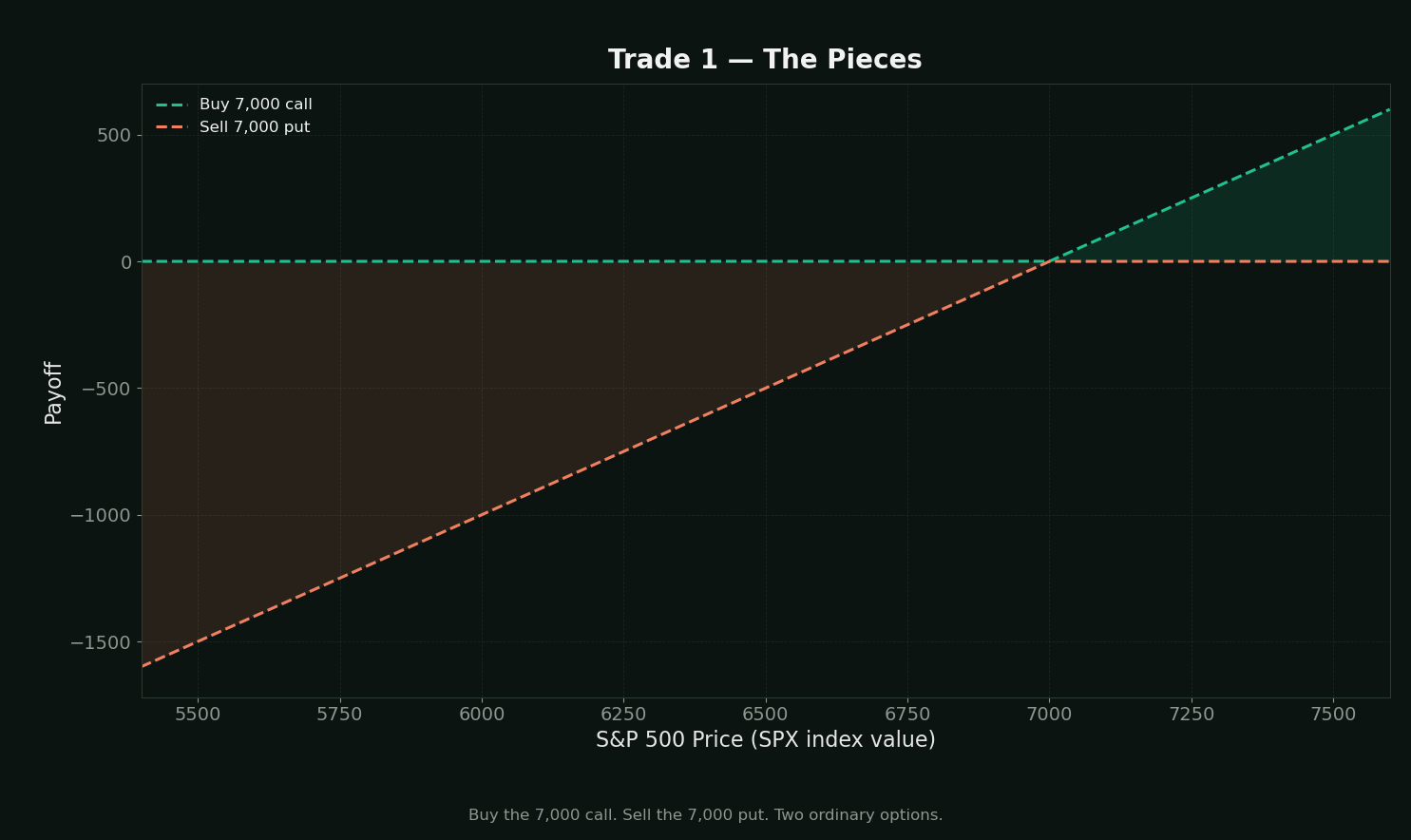
Above 7,000, the call pays you dollar-for-dollar with the market. Below 7,000, the put you sold loses dollar-for-dollar with the market. Put them together and the kinks disappear:
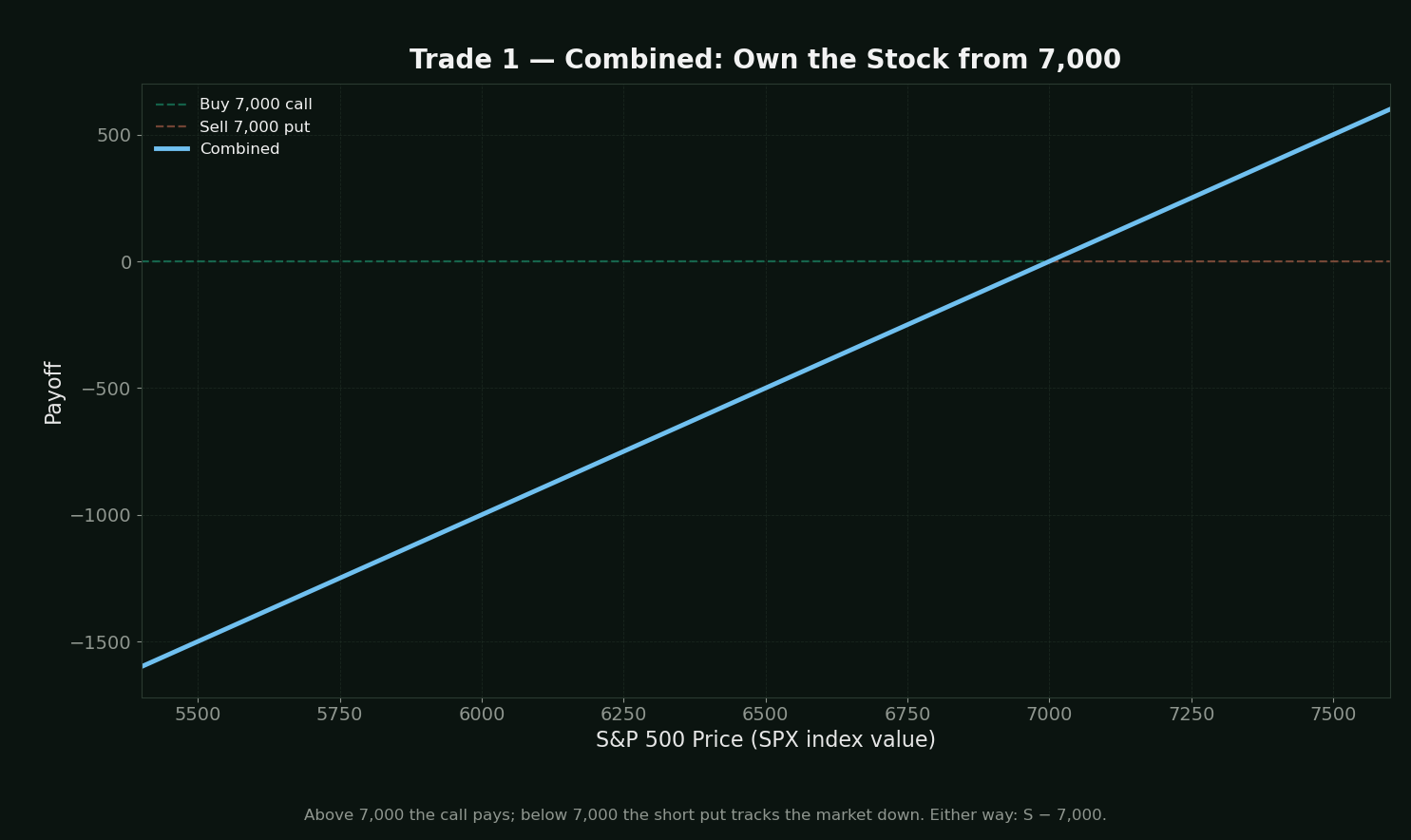
One straight line. You end up with the market’s move measured from 7,000 — exactly what you’d have if you bought the S&P 500 at 7,000.
Trade 2: short the stock from 6,000.
Now the mirror image. Sell the 6,000 call. Buy the 6,000 put:
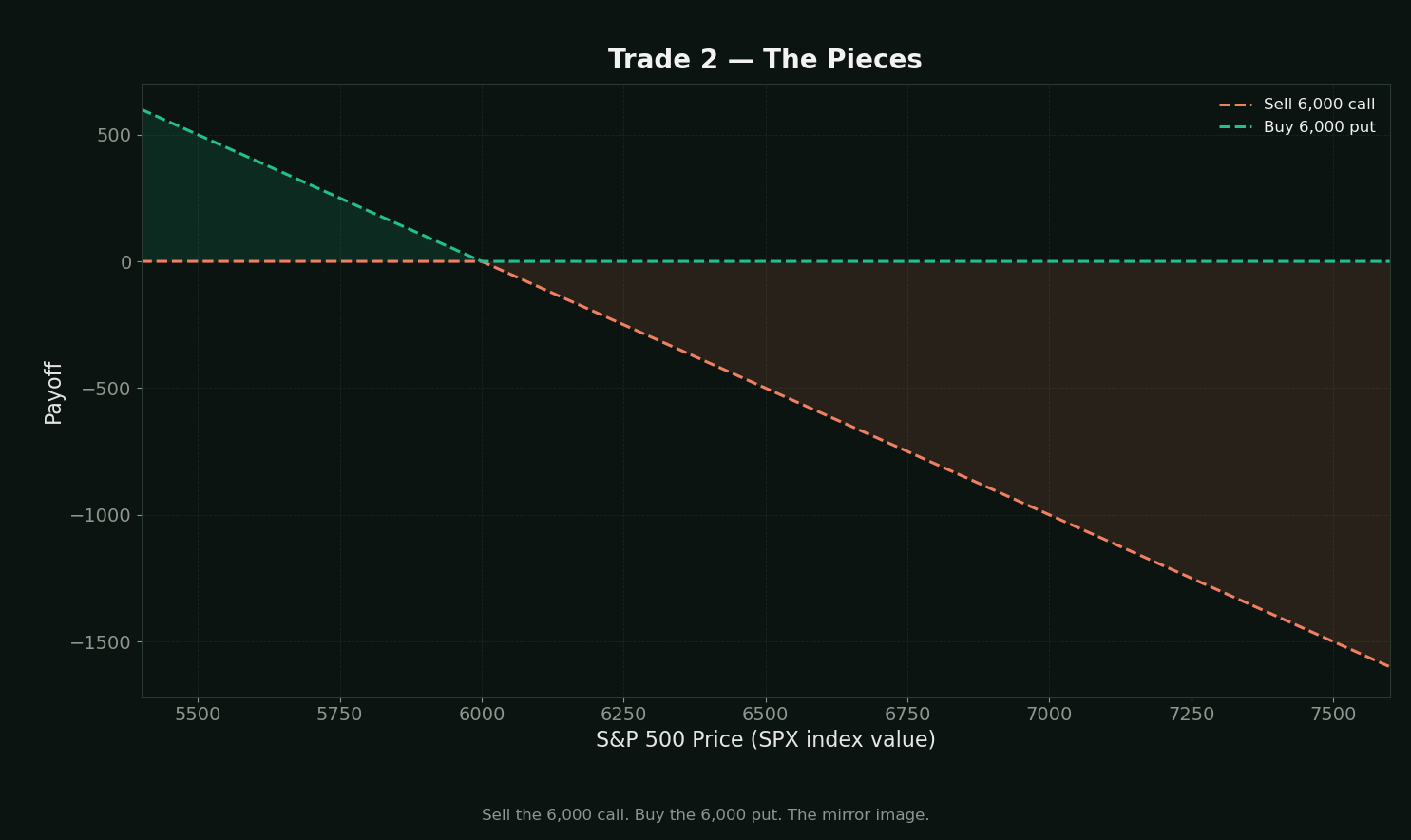
Combined, it’s the same story in reverse:
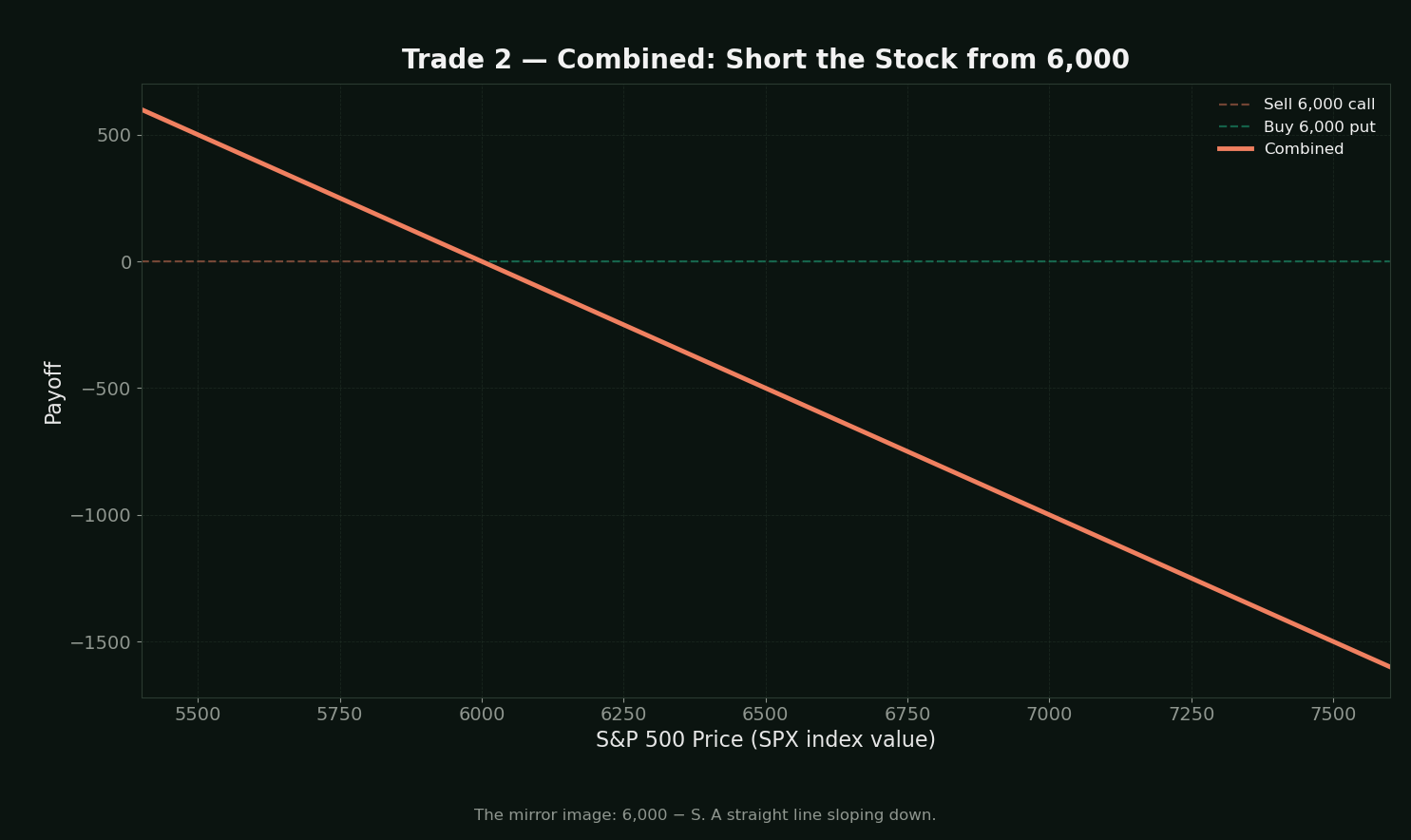
A straight line sloping down — exactly what you’d have if you shorted the S&P 500 at 6,000.
So the intimidating four-legged box is just this: long the market from 7,000, short the market from 6,000.
The Punchline: The Market Cancels Out
Here are your two trades together:
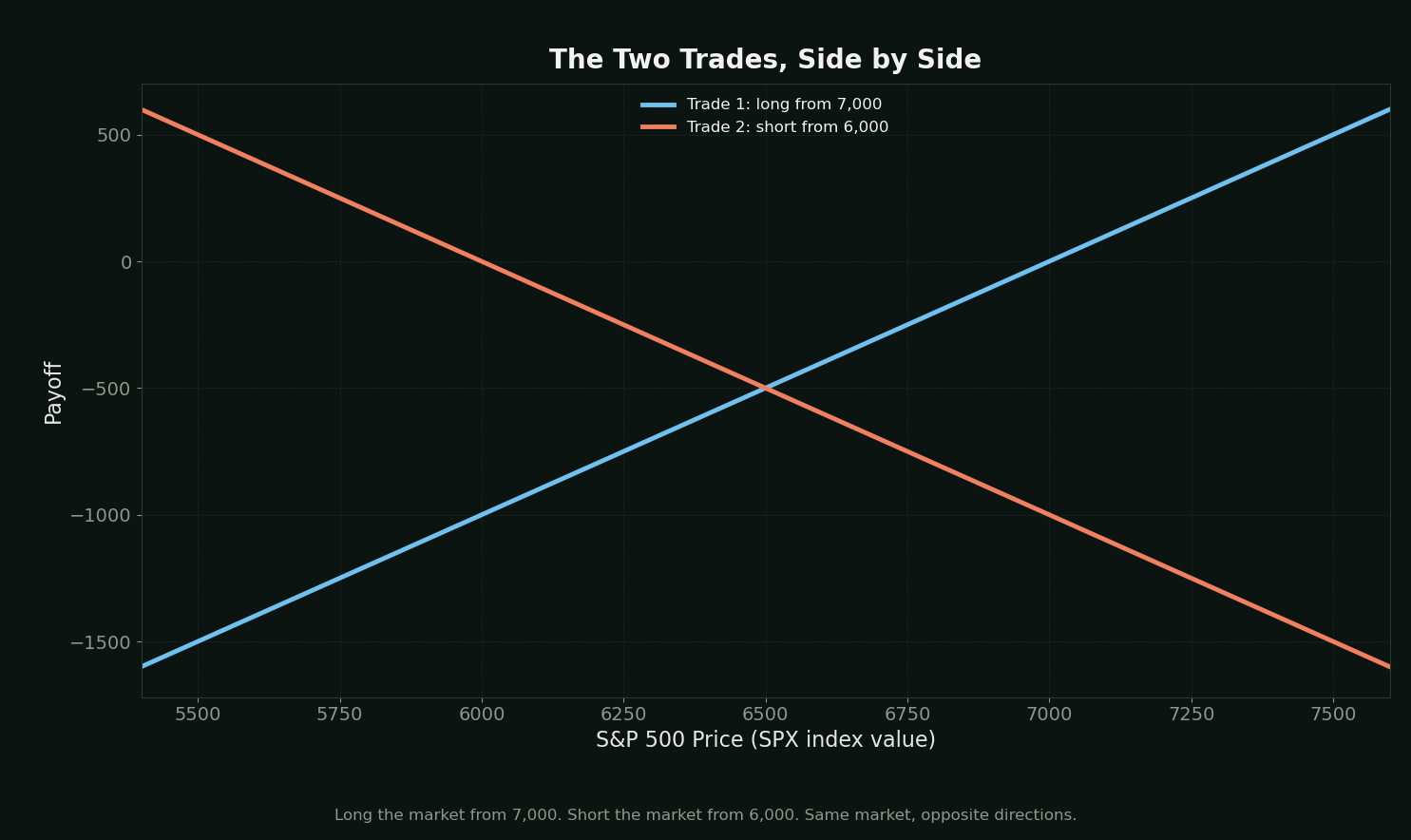
Now add them:
(S − 7,000) + (6,000 − S) = −1,000
Being long and short the market at the same time results in having no net exposure. The only thing left in the trade is -1,000 index points or $100,000 due at expiration.
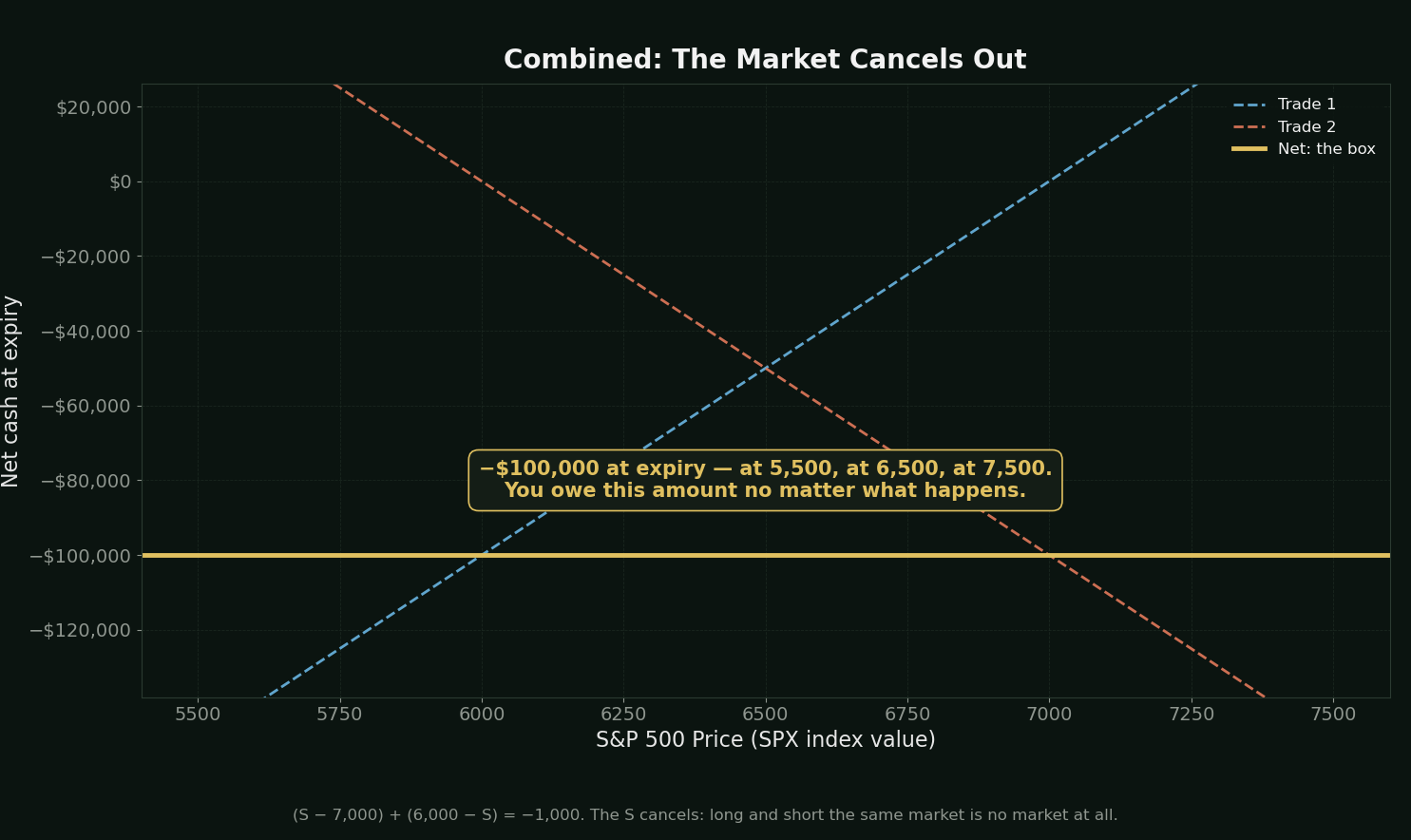
You must lose $100,000 at expiration — at 5,500, at 6,500, at 7,500, no matter what happens. A guaranteed future loss of a fixed amount is just a debt by another name.
From Options to a Loan
So what does the market pay you today for the promise to lose $100,000 in a year? Say $95,785 hits your account when you sell the box:
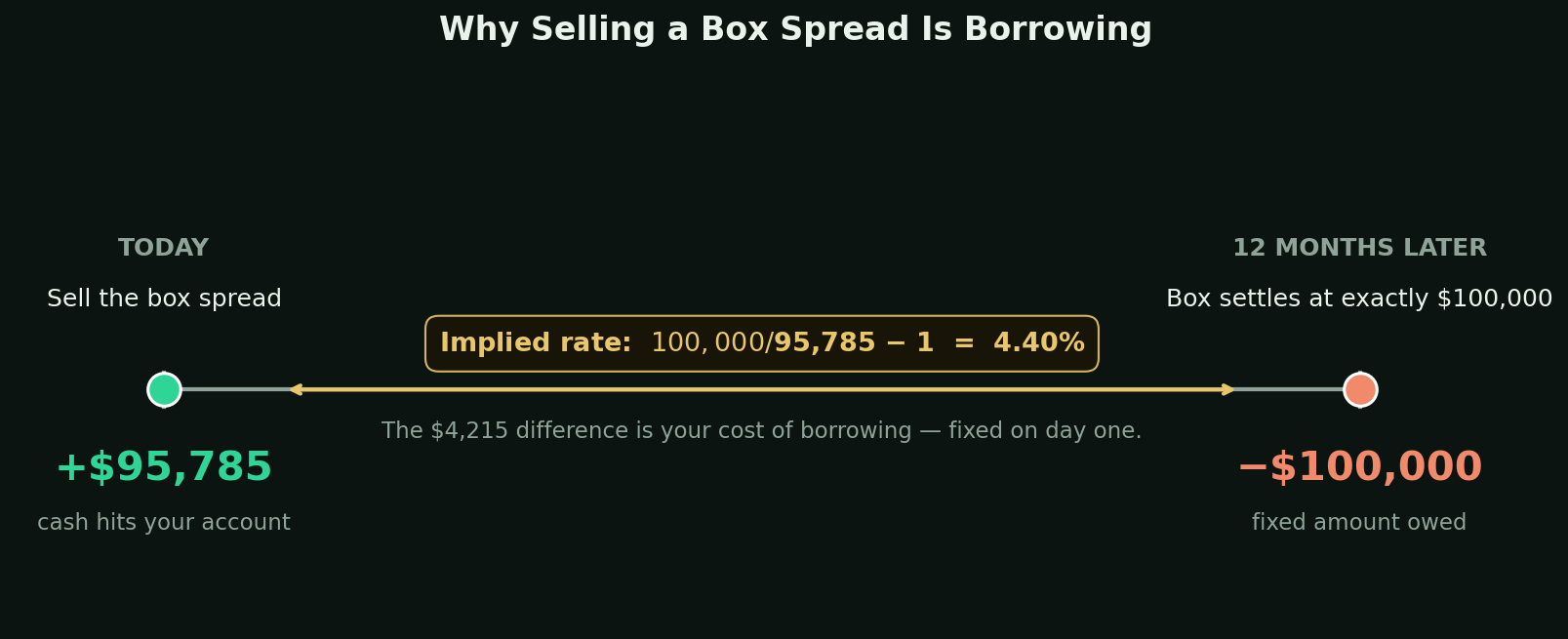
Cash in today with a fixed amount paid later is equivalent to a loan. The $4,215 difference between what you received and what you repay is your cost of borrowing, which is known on day one.
The Implied Rate
The math is one line:
Implied rate = ($100,000 ÷ $95,785) − 1 = 4.40%
Note: this example uses simple interest for simplicity. The calculators on this site compound daily, following market convention — the difference over a year is small, but we use the precise math where it counts.
The market sets the price of the structure, and the price sets your rate. This is the essence of why the rates are so competitive and low: nobody at a bank decides what you pay — the option market bids for your loan and you take the best price available.
Why the Rate Tracks Treasuries
This is the part skeptics ask about: why should this rate be low? Because of arbitrage.
A box spread is a guaranteed future payment. If boxes ever traded at rates far above Treasuries, every trading desk on earth would buy boxes and short Treasuries for a risk-free profit. If they traded far below, they’d do the reverse. That constant pressure pins box spread rates near benchmark government rates — roughly the rate at which the U.S. government itself borrows. That’s the structural reason this financing is 2–3% cheaper than a mortgage: you’re borrowing at institutional rates, not retail ones.
If you have a portfolio and need financing, I’m happy to talk through whether box spreads make sense for your situation. Feel free to reach out to me either via email jimmy@meetalterra.com or on LinkedIn.